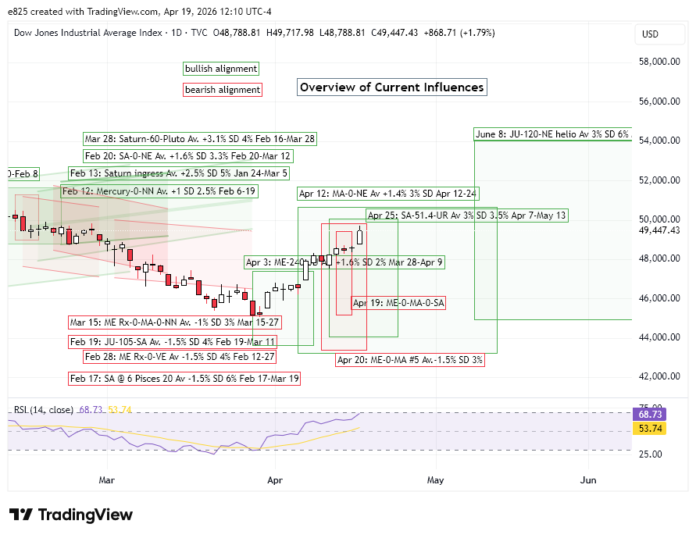
(19 April 2026) Stocks rallied for the third straight week after the US blockade of the Strait of Hormuz signaled a possible end to the conflict with Iran. Recent gains have seen the main indexes push to new all-time highs as investors have largely put Middle East geopolitics in the rear-view mirror.
The size and speed of the rally has been somewhat surprising as the Mercury-Jupiter aspect in early April tends to have only a modest bullish influence. Also, I had thought the approaching Mercury-Mars conjunction — the fifth in the current sequence that began in October — tends to have a bearish effect on stocks. The key word here is “tends” as backtesting of previous similar conjunctions showed a fairly wide distribution of outcomes even if the negative ones outnumbered the positive.
I would also note the quadruple geocentric conjunction of Mars, Neptune, Mercury and Saturn from April 12 to April 20 was unprecedented. This four-planet alignment has never occurred in the past 130 years for which we have data for the DJIA. As such, it became a bit of a wild card with unpredictable consequences. Even the triple conjunction of Mercury, Mars and Saturn on April 19-20 was very rare and has only occurred three times since 1896. As I discussed previously, these three previous alignments had widely disparate outcomes — one bearish in 1966, one neutral in 1996 and one bullish in 1998. I thought the absence of other bullish or bearish alignments this time around pointed to a more neutral and choppy market outcome but that clearly was not the case.
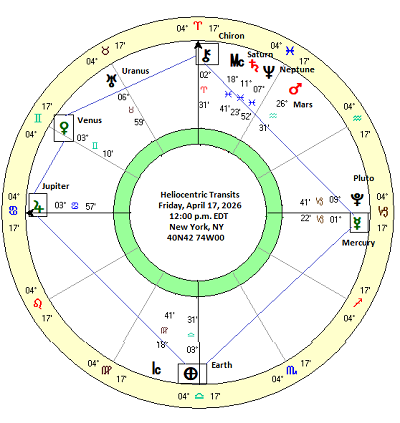
In hindsight, the heliocentric chart may have held the key to this huge April rally. As the chart above shows, bullish Jupiter formed a very tight, degreewise alignment with the Earth, Venus, Mercury and Chiron as all five planets were between 1 and 3 degrees of their respective sidereal signs. That is also rare (occurring just twice before during the past 130 years) and statistically-based predictions more difficult.
We can also make honorable mention of Jupiter’s sidereal transit conjunction with the 7:52 a.m. Ascendant of the NYSE horoscope. On Friday, April 17, Jupiter (23Ge07) was just a eight arc minutes past an exact conjunction with the NYSE Ascendant (22Ge59). Jupiter is currently moving at a rate of 6 arc minutes per day and was exactly conjunct the Ascendant on Thursday. This conjunction only occurs once every 12 years and should also be considered a bullish influence. And we should note that these are sidereal positions using the Lahiri/Krishnamurti ayanamsa which are precession-corrected. In the tropical zodiac this Jupiter-Ascendant conjunction occurred way back on Aug 10, 2025. Score a point for the sidereal zodiac there.

Alignments as possible turning points
Nonetheless, this bullish heliocentric transit alignment is now separating as the faster-moving planets (Earth, Mercury, Venus) move out of alignment with Jupiter and Chiron. This may correspond with a loss of optimism and opens the possibility for some downside in the days ahead. Also, Monday’s Mercury-Mars conjunction could also bring a trend change as those planets begin to separate from Saturn and Neptune. In that respect, it is possible that these multi-planet conjunctions can act as turning points for prevailing trends.
This does not mean that a major pullback is imminent, however. In fact both of those geocentric and heliocentric alignments should be seen as intermediate term reservoirs of bullish energy which can see stocks extend their rally beyond their exact dates (Apr 17; Apr 20). But the short term outlook argues for some bearish mean reversion in the days ahead.
Another reason why a deep pullback is unlikely is due to the bullish influence of the upcoming Saturn-Uranus septile on April 25. Our previous study showed how this alignment had a bullish bias which manifested more in the days and weeks after the exact alignment. The updated cumulative trend charts below show the bullish tendency of this aspect for both the 51-degree septile alignment (n=13) and the larger, multi-septile sample for 51-, 102- and 154-degree alignments. (n=63).
Another leg higher? — the Jupiter-Neptune trine
Besides the probable bullish impact of the Saturn-Uranus septile, there is some reason to think that the current rally will last into May and June, if not longer. There are several favorable alignments upcoming, including the heliocentric Jupiter-Neptune trine on June 8. Most Jupiter aspects are seen as generally bullish although they remain subject to verification with backtesting. In my experience, Jupiter-Neptune geocentric aspects really are bullish although I am less familiar with the heliocentric aspect.
The table below shows the closing prices for the DJIA at 5-day intervals before and after Jupiter forms a 120-degree heliocentric alignment with Neptune from 1898 to 2026. The sample consists of 20 prior cases of both the 120-degree and 240-degree trine aspect.
The summary statistics table below suggests this alignment has a modest bullish effect. The first column (“-30d 30d”) lists the average price change during a 60-day window around as 2.44% — well above the benchmark figure of 0.85%. This was close to the median figure of 1.91% although with a high standard deviation near 6%, this failed to reach statistical significance. Indeed, none of the tested intervals reached significance although the 10-day interval preceding the alignment (“-10d 0d”) came close to the significance threshold of 0.05 with a p-value of 0.09. Nonetheless, most intervals showed a bullish net lean as both the average and median were well above the benchmark.
The cumulative trend chart below displays this bullish influence. Both the average and medians lines rise above the benchmark in the period preceding the exact trine aspect. The period after the exact aspect was more volatile, however, as the median line actually dipped sharply into the negative around the “20d” mark.
Since Jupiter and Neptune will be separated by 120 degrees in the upcoming June 8 alignment, it is worthwhile to examine this subset of cases separately from the larger sample. The cumulative trend chart below shows a very similar pattern although it is generally a more positive chart with the overall 60-day price change exceeding 3% for both average and median compared with 1.91/2.44% for the combined sample of 120-degree and 240-degree aspects. Interestingly, the dip at 20 days after the alignment is in this chart also, although it is more muted. Despite the dip after the exact aspect, both the average and medians end up rising to new highs by the “30d” mark. A happy ending of sorts.
Implications for this week
The heliocentric Jupiter-Neptune trine aspect is unlikely to exert an influence this week as its date of exact alignment still too far in the future. Therefore, the two separating alignments may be more significant short-run factors. The geocentric Mercury-Mars-Saturn conjunction carries some downside risk, especially given the rally in the days leading up to the conjunction. A conjunction may therefore act as a pivot for the market. In addition, the specific fifth Mercury-Mars conjunction is also a potential source of volatility, although its negative effects have so far not manifested at all.
The separation of last week’s Jupiter-centered heliocentric alignment is another possible source of market weakness. If markets rose during the approach of this alignment, there is a real possibility of some downside as the alignment separates.

Disclaimer: Not intended as investment advice. For educational purposes only.


