An unstoppable rally: Jupiter and the NYSE chart

(10 May 2026)  US stocks finished higher again last week as optimism about AI-related earnings outweighed the underlying geopolitical uncertainty.  The tech-heavy NASDAQ posted its sixth consecutive winning week and carried the S&P 500 and Russell 2000 along with it. The broader market failed to keep pace, however, as the NYSE Composite actually closed lower.

The upside was not unexpected given the mostly favorable alignments that are in effect.  Our study of the post-alignment period of the April 25 Saturn-Uranus septile (51.4 degrees) suggested a bullish bias and that has certainly been evident in recent price action.   While the current Saturn-Uranus alignment has far exceeded its long-term average, it is more closely following the price pattern in cases where significant gains have already accrued before the day of the exact septile aspect.

In cases in which stocks have gained 3% or more during the 18-day run-up to the multi-septile alignment (51.4/102.9/154.3), there are usually continued gains in the 18-day period following the alignment, albeit with a lower rate of increase.  The updated cumulative trend chart below shows this clearly as the current alignment (red line) is tracking previous bullish alignments quite closely.  Further gains are definitely possible in the days ahead, although more sideways chop may be another very real scenario.  We should also note that the Dow Jones Industrials (DJIA) has been trailing the S&P 500 and NASDAQ in recent days so this chart underestimates the extent of the post-alignment gains.  But since the original backtest used the DJIA, we should track the Dow in the interest of consistency.

It would seem that stocks could continue to push higher for a while longer.  As discussed in previous posts, there are a number of bullish influences due in May and June.  The approaching heliocentric alignment of Jupiter, Uranus, Neptune and Pluto in June has some bullish potential, even if the May 30 Jupiter-Uranus alignment is not as bullish as one might expect.  This same bullish four-planet alignment occurs in geocentric coordinates in July and could conceivably extend the rally into the summer.

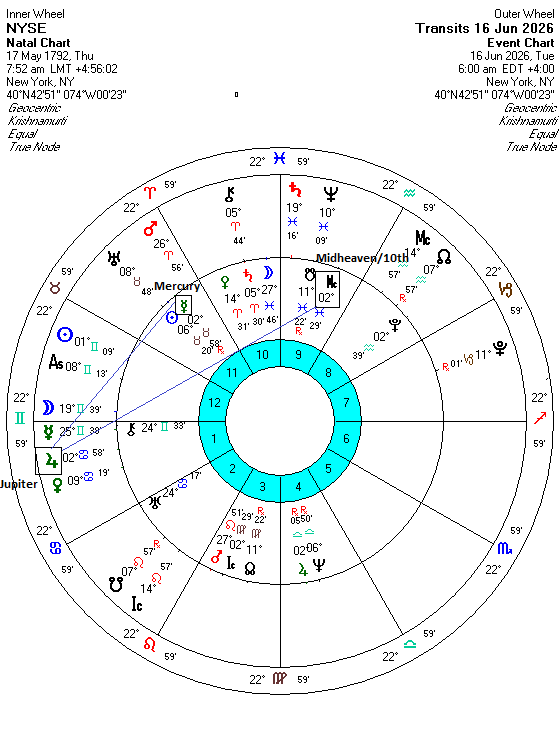
Jupiter (2Cn58) sextile NYSE Mercury (2Ta58)

Another favorable alignment in the May-June period is Jupiter’s alignment to the NYSE horoscope. (See chart above) Specifically, Jupiter will form a 60-degree sextile aspect with natal Mercury in the NYSE chart in mid-June.  Using a precession-corrected sidereal zodiac position (Krishnamurti ayanamsa), Jupiter (2Cn58) will align exactly with natal Mercury (2Ta58) on June 16.  Interestingly, Jupiter will also form an exact 120-degree trine aspect with the Midheaven (unequal 10th house cusp or “Mc”) of the widely-used 7:52 a.m. horoscope for the NYSE.  This double Jupiter transit could therefore be significant in terms of market outcomes.  Since Jupiter is a bullish planet, its transit to natal Mercury and the Midheaven is a hypothetically bullish influence that requires verification.

While some readers may be less familiar with the sidereal zodiac, its usefulness is more apparent when analyzing older charts such as the NYSE (May 17, 1792).  The precession of the equinoxes means the original natal positions in the NYSE chart move about 1 degree every 70 years.  At present, there is a 3-degree offset between current planetary positions and their original position in 1792. In other words, the tropical zodiacal position of Mercury has moved 3 degrees from its original position.  By using the sidereal zodiac, the Jupiter transit to 2Cn58 ensures that the sextile will align exactly with the original position of Mercury at 2Ta58 as reckoned by a fixed star frame of reference.

The table below shows the closing prices on the DJIA for all the conjunctions of Jupiter with 2 degrees of Cancer and 58 minutes since 1896.  Due to Jupiter’s relatively slow velocity, the resulting dataset is quite small at just 14 cases.  The table shows the changing prices at 5-day intervals before and after it transits over 2Cn58.  The first column lists prices 30 days before the transit (“-30d”) and continues until the final column which gives prices 30 days after the transit (“30d”).

The summary statistics table below shows the price changes across various intervals.  The first column is a 60-day window that begins 30 days before the conjunction and last until 30 days after.  (“-30d 30d”).  The results are mixed.  Even in that first column, the mean is negative (-0.56%) while the median is quite positive (2.21%).  Given the small dataset, it is difficult to favor one over the other.  The best assessment may be to simply acknowledge that the results are neutral.

But if we look more closely at the other intervals, a pattern emerges.  The periods before the exact conjunction tend to be bullish, while the periods after tend to be bearish. The second column (“-30 0d”) shows a mean change of 1.87% in the 30 days leading up to the Jupiter conjunction to 2Cn58.  This is quite bullish since the median is roughly similar and both are well above the long term benchmark average of 0.42% for any random 30-day interval based on a 5.1% average annual return for the years 1907-2014.  However, the high standard deviation (7.06%) suggests the data vary widely and lack a consistent direction.  Not surprisingly, the result is not significant and has a p-value of 0.471 — well above the 0.05 needed for statistical significance.

But the period after the conjunction gets very close to significance (p = 0.07) as both the mean (-2.25%) and median (-2.62%) are decidedly negative and well below the 0.42% benchmark. This same pattern of bullish before and bearish after is repeated across most of the interval pairs. None reach significance but a few come close which is noteworthy given the very small sample size.

This bullish before/bearish after pattern is shown clearly in the cumulative trend chart below.  Both the mean and median lines are above the benchmark line before the “0d Jun 16” marker but then both turn lower.  The mean turns sharply lower while the median mostly goes sideways-to-lower for the remainder of the backtest period.

The bottom line here is that the Jupiter-Mercury sextile should be seen as yet another bullish influence for the market in late May and early June.  However, this bullish influence is likely to fade after June 16 and could even turn bearish.

Implications for this week

Since we are still five weeks away from this Jupiter-Mercury alignment and thus still prior to the backtest period, there are no immediate implications this week.  Nonetheless, the medium term outlook into the summer still seems mostly bullish.

However, there is a Jupiter-centered alignment that could sustain the rally for another day or two.  The Sun (26 Aries) and Venus (26 Taurus) will form exact degreewise alignments with Jupiter (26 Gemini) on Monday with Mercury (25Aries) joining the alignment on Tuesday.  While I have not backtested the market effects of this alignment, there is some apparent bullish energy here.  Once this alignment starts to separate on Tuesday-Wednesday there is a growing risk of some downside as sentiment may shift.

Disclaimer: Not intended as investment advice.  For educational purposes only.

Get notified whenever we post something new!

Continue reading

Marco Rubio on the rise

(7 May 2026) The state of US politics is as volatile as ever.  Much of the uncertainty is due to President Donald Trump whose bull-in-a-china-shop mercurial style often leaves rivals and opponents exasperated and on the defensive.  The ongoing...

Appearances can be deceiving: the helio Jupiter-Uranus sextile

(3 May 2026) Stocks pushed higher last week as tech earnings from the likes of Apple and Google came in stronger than expected while jobless claims remained steady.  The S&P 500 and NASDAQ reached new highs, although the Dow...

Market pullback in Jupiter’s wake?

(26 April 2026)  Stocks were mixed last week as growing doubts about the US-Iran peace talks were offset by strong semiconductor earnings led by Intel.  While the NASDAQ and the S&P 500 hit new record highs, the Dow and...

Enjoy exclusive access to all of our content

Get an online subscription and you can unlock any article you come across.