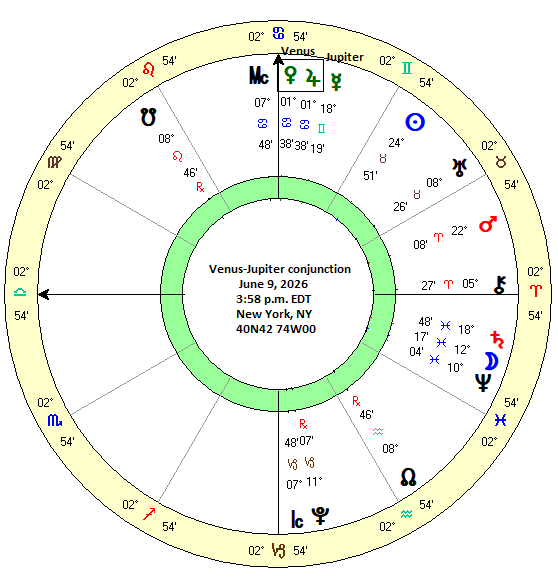
A benefic alliance: the Venus-Jupiter conjunction

(24 May 2026)  US stocks continued their powerful rally last week as strong Nvidia earnings and renewed hopes for a peace deal with Iran pushed the S&P 500 higher for the eighth straight week.  Crude oil fell sharply closing under $100 and took the pressure off Treasury yields as bonds followed stocks higher.

The positive week was in keeping with our overall expectations given the bullish bias of the approaching Mars-Pluto square on May 25 and the broader Mars-Pluto-North Node alignment.  Last week’s backtest study suggested that both alignments had a bullish bias and several of the tested time intervals reached statistical significance (p < 0.05).

The updated cumulative trend chart for the Mars-90-Pluto square (n=27) shows prices generally tracking the mean and median lines higher, albeit with a normal amount of choppiness.  Of course even a strong bullish bias in past squares is no guarantee that stocks will rise through the course of the current square.  Every case is unique and has distinctive co-factors which can determine the eventual path of stock prices apart from any historical mean.  But the fact that previous squares corresponded with higher stock prices well after the exact 90-degree square is still useful information.  The Mars-Pluto square is therefore clearly a tailwind for stocks at least until the end of the backtest period (“15d”) which equates to June 9 for the current alignment.


It is a similar story for the updated cumulative trend chart for the Mars-Pluto-North Node alignment (n=19). This is also a generally bullish influence both before and after the day of the exact alignment, although we should note a greater amount of choppiness in the chart. The progress of the current alignment is falling a bit short of previous averages although the period immediately before and after has generally seen the largest rises.  This could translate into more gains this week upcoming as the red current line plays catch up to the mean and median lines.  We shall see.


A benefic alliance: the Venus-Jupiter conjunction

Our backtest study this week is the potentially bullish conjunction of Venus and Jupiter.  The conjunction of these traditionally bullish planets will occur on June 9, 2026.  According to standard assumptions of financial astrology, even having just one or the other of these planets involved in an alignment is usually sufficient to create a bullish bias in the market.  Since it is the slower-moving of the two, Jupiter alignments are usually seen as more bullish of the two since its alignments can last for several weeks.

Hypothetically then, the coming together to two bullish planets should coincide with some gains.  Given the relatively fast motion of Venus, however, this conjunction doesn’t last very long.  Using a tight 3-degree orb, this conjunction will only be effect for 5 or 6 days. And if we follow the conventional assumption that the most effective period occurs just before an alignment is exact, its actual bullish influence may only last 2 or 3 days.   It is therefore quite possible that it may not exert a dominant influence on the overall market.  But before jumping to any conclusions, let’s first look at the data.

The table below lists the S&P 500 closing prices at 3-day intervals for the past 49 Venus-Jupiter conjunctions from 1980 to 2026.  Since geocentric Venus travels at a speed just slightly faster than the Sun, there is about one Venus-Jupiter conjunction per year.  The first recorded price is 18 days before the conjunction (“-18d”) and the last recorded price is 18 days after the conjunction (“18d”).  While these start and stop points are arbitrary, the resulting 36-day window should be long enough to see if there is any particular price pattern before and after the conjunction.


The summary statistics table below shows price changes across various intervals.  The results are actually fairly mixed.  The first column (“-18d 18d”) has a mean of just 0.14% and a median of 0.89%.  These are both quite close to the expected benchmark of 0.91% based on a 9.2% average annual return for the S&P 500 for the years 1980-2025.  Actually, this sort of unremarkable result shouldn’t be too unexpected since the likely effect of the Venus-Jupiter conjunction would only last for a few days. Therefore, it would be quite surprising to see a major effect during a much longer 36-day period.   Due to a couple of cases which featured large declines (Aug 1990 and Apr 2022), most of the interval means are lower than the medians, especially in the longer intervals.  For that reason, the medians may be a better barometer of the conjunction’s likely effects than the means.  Since the medians are generally very close to the benchmark, this suggests there is very little or no net effect for this conjunction.


A more interesting picture emerges in the shorter intervals, however.  The 12-day and 9-day intervals are evidence of the standard astrological assumption of ‘bullish before’ and ‘bearish after.’  While there is little effect across the 18-day interval (“-9d 9d”) the 9 days that precede the conjunction (“-9d 0d”) had a net bullish lean (mean 0.75%; median 1.24%) as both measurements exceeded the benchmark of 0.23%.  This failed to achieve statistical significance (p < 0.05), however, with a p-value of 0.152.  Close but no cigar.  Moreover, the 9-day period after the conjunction was bearish (mean -0.31%; median -0.42%) although this also fell short of reaching significance (p = 0.142).  A similar ‘bullish before/bearish after’ pattern is evident in the 12-day window (“-6d 6d”) although this effect was weaker.

We should also note, that the effect seems to disappear for the shortest intervals of 6-days (“-3d 3d”) and 3-days (“-3d 0d; “0d 3d”).  This may be reflect the secondary nature of the conjunction when compared with other, more dominant alignments.  Alignments need not manifest exactly on the day of their precise conjunction.  This is one reason why a somewhat wider window or 12 or 18 days is more useful when considering its potential effects.

Nonetheless, the cumulative trend chart highlights the bullish before/bearish after phenomena of this planetary pairing, albeit with some qualification.  The period before the conjunction is actually a bit bearish if we extend the period back to 18 days before.  The most bullish period is therefore from 9 days before to the day of the conjunction.  This equates to May 31 to June 9 for the approaching conjunction.  It is also worth noting that the bearish phase after the conjunction only lasts about 9 days on average.  This is more evidence of the secondary nature of the effects of the Venus-Jupiter conjunction.


And since none of the intervals reached statistical significance, we should take this result with a grain of salt.  There is a lot of room for other outcomes with this conjunction and the path of the price changes of the current conjunction may ultimately bear no resemblance to the mean and median paths shown here.

Implications for this week

The Venus-Jupiter conjunction is unlikely to have any obvious effect of stocks this week.  If the backtest holds any relevance at all, it would suggest some relative weakness this week before the most bullish phase of the conjunction begins from May 31 to June 9.  And yet without statistical significance and no interval above 70% in terms of  “% positive”, the approach of this conjunction is not sufficient reason to expect further gains.  But as part of a larger picture, it does provide more evidence for a mostly bullish bias for the next several weeks.

The ongoing bullish effect of the Mars-Pluto square and the Mars-Pluto-North Node alignment could well have the last word this week upcoming.  If we do happen to see some downside in the coming days, these backtest studies suggest it is likely to be quite limited in scope.

Disclaimer: Not intended as investment advice.  For educational purposes only.

Get notified whenever we post something new!

Continue reading

Surprisingly bullish: Mars-Pluto-Rahu

(17 May 2026)  Stocks were mixed last week as inflation worries pushed bond yields higher as the 30-year Treasury closed above the 5% level.  With no resolution in sight to the Iran conflict, investors are now beginning to factor...

An unstoppable rally: Jupiter and the NYSE chart

(10 May 2026)  US stocks finished higher again last week as optimism about AI-related earnings outweighed the underlying geopolitical uncertainty.  The tech-heavy NASDAQ posted its sixth consecutive winning week and carried the S&P 500 and Russell 2000 along with...

Marco Rubio on the rise

(7 May 2026) The state of US politics is as volatile as ever.  Much of the uncertainty is due to President Donald Trump whose bull-in-a-china-shop mercurial style often leaves rivals and opponents exasperated and on the defensive.  The ongoing...

Enjoy exclusive access to all of our content

Get an online subscription and you can unlock any article you come across.