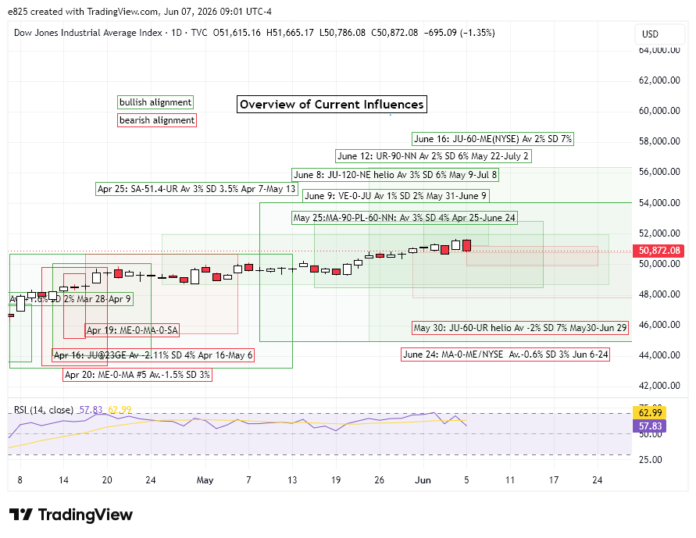
(7 June 2026) US stocks sold off sharply last week as an unexpectedly strong jobs report raised the specter of interest rate hikes. AI and technology stocks got hit the hardest as the NASDAQ fell almost 5% in Friday’s session.
While I had been uncertain about how last week would play out, the size of the decline was quite unexpected. Even if we see further downside from here, the ongoing alignments we are tracking this summer seem more bullish than bearish. Therefore the more likely price path may still be up, albeit not in a straight line.
The updated cumulative trend chart of the Uranus-North Node square was not impacted by last week’s sell-off and is still tracking well above its historical norms. This is partially because this study used the Dow Jones Industrials which were only down fractionally last week. Also its most recent data point was June 2 — well below the market began its decline. In that sense, this chart may be less representative of the current situation.
Although the Uranus-North Node alignment is symbolically associated with volatility and sudden changes, the data suggest that this is actually a bullish influence, especially during the period after its square alignment on June 12. Most of the upward movement in the chart occurs after the “0d” of the alignment, although price is very choppy. Nonetheless, some downside would not be surprising in this chart given the natural tendency for mean reversion. The current price trajectory is so far above historical averages that it wouldn’t be surprising to see some downside to bring in closer to the mean and median lines.
Turning to the updated cumulative trend chart of the Mars-Pluto square, last week’s sell-off has definitely reset this one. The current square on May 25 (red line) is now tracking well below the mean and median lines. The huge dip is a result of the study using the S&P 500 instead of the DJIA and the fact that Friday’s closing price was included in the data in accordance with its 3-day interval sequence.
While this chart is fast approaching the end of its test period (15d = June 9), it is quite possible it could revert to its mean and turn positive in the days ahead. In this respect, its potential for a positive mean reversion may offset the possible negative mean reversion in the Uranus-90-North Node chart. As a rule, these single planetary influences are rarely strong enough to determine price direction by themselves. They are only one piece of a complex puzzle.
The related Mars-90-Pluto-60-NN alignment is holding up rather better, although for reasons already mentioned — it tracks the DJIA and not the tech-heavy S&P 500 and its last piece of data was Wednesday, June 3 rather than Friday, June 5. It is still outperforming his historical averages although we do note that upside tends to be more limited during the 30-day period after the exact alignment (May 25). We should therefore not regard this alignment as having much additional bullish effect for the month of June.
Finally, the Venus-Jupiter conjunction is now tracking below its historical norms despite being in a relative bullish interval just before its exact conjunction. It could reverse higher in short order as mean reversion kicks in but we also shouldn’t be too surprised if it doesn’t since its net effects were fairly small and not statistically significant.
Overall, these alignments present a mixed picture for the month of June. While they are net bullish in their general effects, much of the upside may have already manifested given the new all-time highs that printed last week.
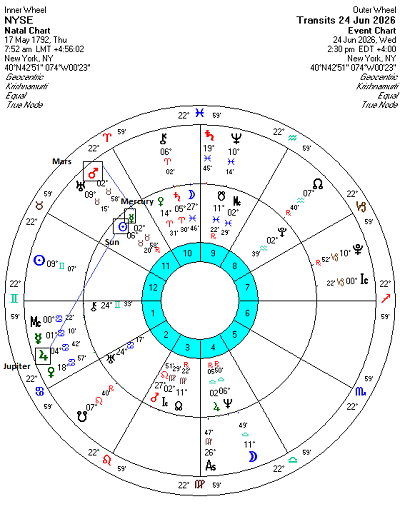
Mars conjoins NYSE Mercury: June 24
If the current transits lack clear direction, another approach is to examine any transit hits to the NYSE horoscope (May 17, 1792 7:52 a.m. LMT). We have already noted the possible bullish effects of the Jupiter sextile to natal NYSE Mercury on June 16. Our study found that this is a mild bullish influence during the period leading up to the exact sextile alignment. The period after the alignment tended to be somewhat bearish. None of the results reached statistical significance, however.

Shortly after the June 16 Jupiter-Mercury sextile, Mars will conjoin the NYSE Mercury at 2 Taurus 58 on June 24. We should specify that that is the sidereal position of Mercury in the 1792 NYSE horoscope. The tropical position of Mercury is 23 Taurus 50 and Mars is due to conjoin that point four days earlier on June 20. This difference in the locations of Mercury is due to the precession of the equinoxes which moves the position of planets by one degree every 70 years. For this reason, I default to the sidereal position which more accurately estimates conjunctions after correcting for this precession factor. That said, I acknowledge that tropical positions have their own internal validity and should also be backtested alongside the sidereal positions.
The table below shows the closing prices before and after transiting Mars conjoins the NYSE Mercury. On the face of it, this conjunction may carry some downside risk since Mars is a malefic planet and Mercury is often more vulnerable to affliction than other planets. But is this actually true? The data will tell the tale. To answer this question I compiled a sample of 43 Mars-Mercury conjunctions from 1951 to 2026. Prices were recorded starting at 18 days before the conjunction at 3-day intervals until 18 days after the conjunction. The assumption here is that if this conjunction has a strong price effect it should show up at some point during this 36-day backtest window.
The summary statistics table below shows the price changes across various intervals before and after the conjunction. The first column (“-18d 18d”) had a slightly negative mean (-0.07%) and slightly positive median (0.11%) but both were well below the expected benchmark outcome of 0.71% based on a 7.2% average annual return for the DJIA for the years 1951 to 2024. While this interval has a bearish net lean, it did not reach statistical significance (p < 0.05) with a p-value of 0.13.
The second column shows the price change from 18 days before the conjunction up until the day of the conjunction (“-18d 0d”). The mean was -0.67% and the median was -0.66%, also well below the benchmark of 0.36%. With a p-value of 0.018, this result was statistically significant. And with only 40% of cases positive for that interval, this confirmed its bearish bias. As a point of reference, a random 18-day period should see stocks post a positive result about 60% of the time. The 18-day period after the conjunction (“0d 18d”) tended to be bullish although this was a weaker correlation. The mean and median posted gains of 0.64% and 0.69% respectively while the benchmark was 0.36%.
A similar pattern can be seen in the shorter intervals with the period before the conjunction being more bearish and the period after a bit more bullish. The effects were fairly weak, however, with only one other interval reaching statistical significance, that of the bullish 3-day interval after the conjunction.
The cumulative trend chart below highlights the generally bearish influence of this conjunction. Note how prices trend lower during the period before the exact conjunction (“0d Jun 24”) and then move higher afterwards.
Even with this persistent pattern, the average price change was quite small — less than 1% either way. For this reason, we should be careful about reading too much into this result. This pattern should be considered a mildly bearish influence for the 12 or 18-day period before the June 24 conjunction. As such, it may act as a drag on stock prices and could offset some of the other bullish factors discussed above.
We should also note that the convergence of the low point of both mean and medians at the “0d” mark offers support the sidereal position of Mercury (2 Taurus 58) as the focus of this conjunction. If the tropical position of Mercury (23 Taurus 50) were more resonant with the Mars conjunction, we would expect to see the low point of the mean and medians to occur either 3 or 6 days before the sidereal conjunction given the 4- or 5-day average offset between the two zodiacs. While not a decisive difference, it is food for thought.
Implications for this week
Since we are moving further into the slightly bearish pre-conjunction period this week, more downside would not be surprising at some point. One possible scenario to consider is that the month of June may see sideways consolidation following the huge rally in May.
Nonetheless, the early week Venus-Jupiter conjunction would seem to be a decent bullish set up for an oversold bounce on Monday and perhaps into Tuesday. Wednesday’s Mercury-Saturn square hints at some midweek volatility, however.

Disclaimer: Not intended as investment advice. For educational purposes only.


