

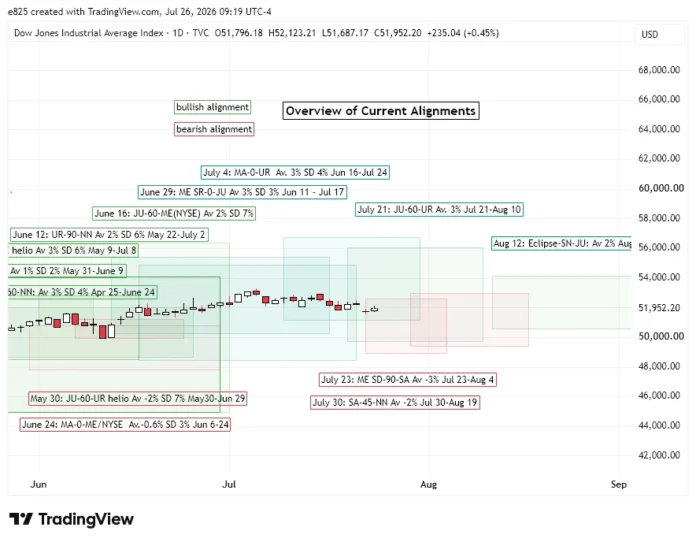
 (26 July 2026) Stocks slumped again last week as renewed hostilities between Iran and US sent oil prices back over $90. The increase in oil prices reawakened reignited fears as bond yields rose ahead of this week’s FOMC meeting. As usual, the NASDAQ took the biggest hit although the beaten-up semiconductor sector actually posted a small gain.
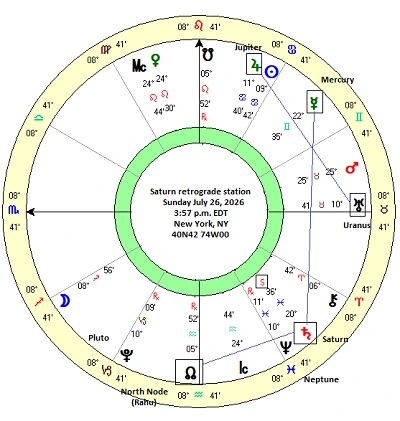
The decline was not unexpected. While stocks rose in the early week on the exact July 21 alignment of Jupiter, Uranus, Neptune and Pluto, the impact of the double-station near-square of Mercury and Saturn was felt later in the week. As noted in previous posts, the July 23 direct station of Mercury while in a near-square alignment with Saturn was more likely to coincide with some downside.
Our backtest of previous similar alignments suggested this was a bearish influence, especially given the retrograde station of Saturn on July 26. The resulting double-station near-square of Mercury and Saturn has a very bearish track record as shown below in the updated cumulative trend chart. Although Mercury-Saturn squares are quite common and occur at least twice a year, Mercury-Saturn squares while Mercury approaches a direct or retrograde station are rare. In order to best replicate the current alignment, we selected only cases in which Mercury stationed direct while in a near-square with Saturn. A “near-square” occurs when Mercury and Saturn approach a 90-degree angular separation within a few degrees — two degrees in the present case — but then Mercury reverses away from it after its directional change.
While the resulting sample consists of just six cases, they nonetheless capture the current planetary set up better than a larger sample of a more common alignment such as a simple Mercury-Saturn square. But the bearish bias in this alignment is clear with a mean peak-to-trough decline of about -3% (and -4% for the median). This is reflected in the fact that the 12-day interval (“0d 12d”) following the Mercury direct station reached statistical significance (p = 0.043) as all six cases produced negative market outcomes…
To read the rest of this post, please visit my Empirical Astrology Substack
