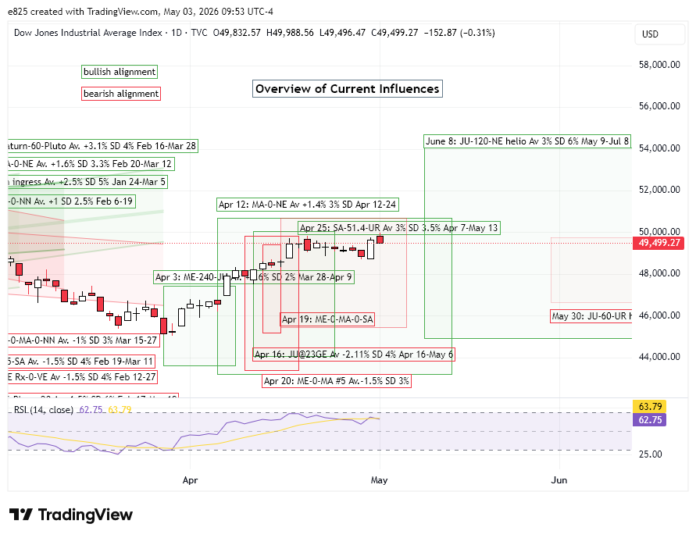
(3 May 2026) Stocks pushed higher last week as tech earnings from the likes of Apple and Google came in stronger than expected while jobless claims remained steady. The S&P 500 and NASDAQ reached new highs, although the Dow and the broader indexes remained slightly below their recent highs.
The positive outcome was not unexpected given the bullish after effects of the April 25 Saturn-Uranus septile aspect. While I had noted the possibility of some downside from the post-alignment effects of Jupiter’s conjunction with the NYSE Ascendant, the data was not robust enough to offset the bullish Saturn-Uranus influence.
The updated cumulative trend chart of the Saturn-Uranus septile is shown below. So far, the current aspect is tracking well above the rising average and median lines. Some mean reversion would not be surprising in the near term as the lines may eventually converge at some point. And yet the upward trend of the post-alignment period may well serve to support prices a while longer.
If we track only cases with a 3% gain or more in the pre-alignment period (n=15), we can see that the current Saturn-Uranus septile is actually fairly close to the average. While most of the gains in these bullish cases occur before the exact alignment (April 25 for the current aspect), the choppy post-alignment period nonetheless allows for further upside. We shall have to see how the current 51.4-degree septile alignment plays out.
The upcoming heliocentric Jupiter alignment
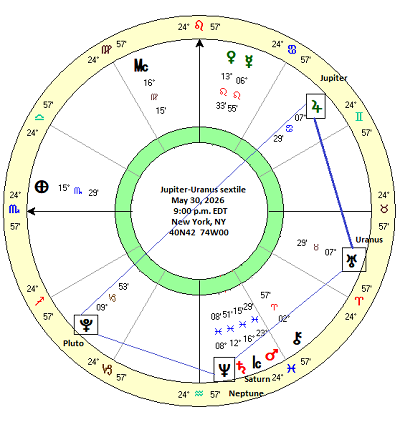
The heliocentric transits in the coming weeks paint a bullish picture. In late May and June there will be a rare four-planet alignment of Jupiter, Uranus, Neptune and Pluto. It is so rare that it has never occurred during the 130-year history of the Dow Jones Industrial Average. The absence of any previous market data for this alignment makes forecasting its price effects especially difficult.

Jupiter is the fastest-moving planet of the four and will form a 60-degree sextile with Uranus on May 30 and then move into a 120-degree trine aspect with Neptune on June 8 and then finally move into opposition with Pluto on July 1. As the planet of optimism, Jupiter alignments are believed to coincide with a rising stock prices — and rising inflation for that matter — so this rare alignment would seem to be tailor-made for further upside.
But without proper data on this alignment, the best we can do is to break it down into its more common constituent parts and evaluate market behavior. Two weeks ago, I backtested the June 8 heliocentric Jupiter-Neptune alignment and found a weak bullish effect. This week we will take a look at the 60-degree Jupiter-Uranus sextile that is exact on May 30.
May 30: the heliocentric Jupiter-Uranus sextile
On the face of it, the Jupiter-Uranus sextile should be bullish. The widely-held view among astrologers is that Jupiter’s optimism blends well with Uranus’ bold, energetic nature. Jupiter-Uranus aspects supposedly bring sudden rewards and gains, especially if the alignment is a ‘soft’ aspect — either a 60-degree sextile or a 120-degree trine. These soft aspects allow for the respective energies of Jupiter and Uranus to combine in a more constructive and auspicious way.
And yet backtesting the DJIA price data for this aspect suggests otherwise. For the purposes of this study, both 60-degree and 300-degree sextiles were included. In both cases, the angular separation is the same — 60 degrees — although the counterclockwise 60-degree sextile has Jupiter moving away from Uranus while the 300-degree sextile sees Jupiter approaching Uranus towards the end of its 15-year synodic cycle. The upcoming May 30 sextile will be a counterclockwise 60-degree aspect in which Jupiter is separating from Uranus.
The table below shows the closing prices for the DJIA at various intervals from 1898 to 2026 for 19 previous Jupiter-Uranus sextiles. Due to the relatively slow velocity of Jupiter and Uranus, a 5-day interval was used in which the first recorded price was 30 days before the exact alignment and the last recorded price was 30 days after the alignment.
The summary statistics table below illustrates the percentage price changes across various intervals. The results are very surprising and even shocking. All intervals produced negative average outcomes and almost all medians as well. The Net Lean was bearish across all intervals. At the same time, it is noteworthy that none of the results reached statistical significance (p < 0.05), a possible reflection of the relatively small sample size. And even though the percentage of positive outcomes is generally below 50%, there are no intervals that are strongly bearish with lower than 30% positive outcomes. This is bearish alignment, but not overwhelmingly so.
The cumulative trend chart below shows that most of the downside occurs during the post-alignment period after the “0d May 30” midpoint — at least according to the median line. The average line is bearish almost from the start of the backtest period but that may be because it is skewed by one single case from November 1929. The Jupiter-Uranus sextile of Nov 17 1929 came shortly after the October 1929 Crash in which stocks fell by more than 30% in a month. At their lowest, the average and medians fell about 2% around the 20- or 25- day mark after the sextile alignment.
If we limit the sample to 60-degree sextiles only (n=9), the price pattern is similar although the effects are even more bearish as the cumulative trend chart below shows. At their lowest, the average and median fall around 4% towards the end of the backtest period near the 25-or 30-day mark. This would equate to a low occurring around June 24-29 for the upcoming Jupiter-Uranus sextile. Again, bracketing the average due to the extreme 1929 case, the median experiences its largest decline after the exact alignment. Indeed, it starts to trend decisively lower fully 10 days after the alignment. This would equate to June 9 for the current case.
Conclusions
There are two main conclusions to this study. First, the heliocentric Jupiter-Uranus sextile is not as bullish as one might have expected. This could be unique to the heliocentric transits which may not apply to the geocentric alignments. But it nonetheless compels us to rethink our assumptions about the Jupiter-Uranus pairing. Not only is the sextile not bullish, it is, in fact quite bearish. While the results are not statistically significant, they all point in the same direction and should be taken seriously. Still, a bearish outcome from the May 30 alignment is far from certain, given the wide distribution of results. The large standard deviation of 7.55% for the longest 60-day window (“-30d 30d”) suggests that this sextile can magnify outcomes in both directions. While the data leans negative, strongly positive outcomes are also possible.
The second takeaway here is that most of the downside likely occurs after the alignment. This suggests that any inherently bearish influence is less likely to manifest in May and is more likely to occur in June, although even that should be taken with a grain of salt given the larger four-planet alignment. The Jupiter-Uranus-Neptune-Pluto alignment will remain within range for the entire month of June culminating in a Jupiter-Pluto opposition aspect on July 1. This is not to say that June will be bullish also, but it means that the bearish post-alignment period of the Jupiter-Uranus sextile could be postponed or negated altogether.
Implications for this week
There are no direct implications of the Jupiter-Uranus sextile this week. As we enter the pre-alignment period, it is unclear if we will experience any direct effect. The bullish post-alignment effects of the April 25 Saturn-Uranus septile may therefore continue to support the market, even if it is less likely to deliver strong gains from here on in.
While some early week downside is somewhat more likely on the heliocentric Mercury-Mars conjunction, some late week upside becomes more probable with Thursday’s heliocentric Venus-Jupiter conjunction.

Disclaimer: Not intended as investment advice. For educational purposes only.


