(26 April 2026) Stocks were mixed last week as growing doubts about the US-Iran peace talks were offset by strong semiconductor earnings led by Intel. While the NASDAQ and the S&P 500 hit new record highs, the Dow and the NYSE Composite were down modestly on the week.
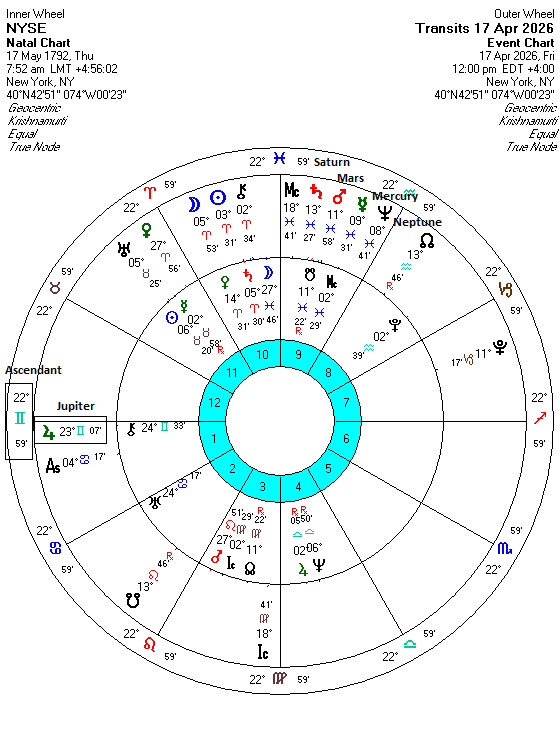
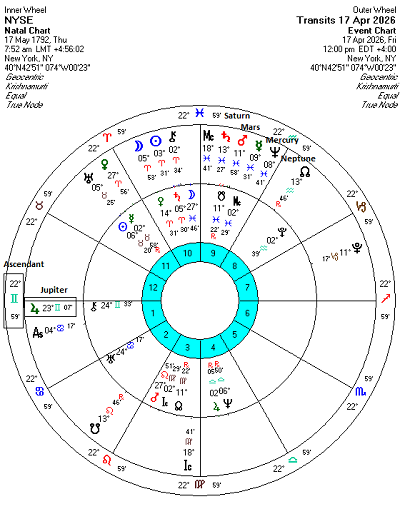
This mixed performance was not unexpected given 1) the bullish influence of the April 25 septile (51.4 degrees) aspect of Saturn and Uranus and 2) the potentially bearish influence of the separation of Jupiter’s conjunction with the NYSE Ascendant at 23 degrees of sidereal Gemini. Since these contradictory influences are likely to remain active this week, let’s dive a bit deeper into their respective effects.
As our previous study showed, the Saturn-Uranus septile is a bullish influence both before and after its exact 51.4 degree alignment. However, its bullish effects tend to be focused more in the period after the exact septile alignment. With the current alignment coming exact on April 25, this would tend to be a bullish influence over the next two weeks at least.
The updated cumulative trend chart below shows the current alignment (red line) is greatly outpacing the average and median lines for this septile. Does this mean we should expect some mean reversion in the coming days as the red line may move lower in order to connect up with its long term average and medians? Not necessarily as we will find out below.
Of course, this septile sample is very small — just 13 cases — so its results should be taken with a grain of salt. Even if the effects are strong and the bullish results statistically significant for several different intervals, the limitations of its tiny sample size means further market upside is by no means a sure thing.
The expanded sample to include multiple septile aspects (51.4, 102.9, 154.3) yielded 63 cases dated from the Dow Jones inception in 1896 and produced similar results, albeit with slightly less bullish effects.
But we can test to see what happens if stocks have been moving strongly higher in the period leading up to the exact alignment. The DJIA is up 5.60% in the 18 days that preceded its exact septile aspect on April 25 (in this study we used the nearest closing price on Friday April 24). Therefore, we want to see what the market does if it is already substantially higher by the time of the exact aspect as it is now. While choosing a cut off is somewhat arbitrary, I chose gains of 3% or greater for the -18d to 0d interval. This was large enough to reflect a clearly bullish applying phase to the aspect but not so big so as to exclude too many other cases.
The resulting sub-sample of 5 cases is shown in the cumulative trend chart below. We can see that the current alignment is more closely tracking the average and median lines for this bullish group. The chart suggests that the while the bulk of the gains may be concentrated in its pre-alignment phase, further upside is still more likely than not, albeit within a choppier market environment.
This same bullish pattern in the post-alignment phase was seen in the multi-septile sub-sample. Consisting of 15 cases, this sub-sample also tended to rise past the exact alignment date (April 25 for the current alignment), even if the rate of increase was lower than the pre-alignment phase.
The bottom line here is that the Saturn-Uranus septile is likely to coincide with more upside in the 18 days that follow its April 25 alignment. This would suggest a bullish bias until May 13, all other things being equal.
After the Jupiter conjunction
Of course, all other things are never equal. Last week I speculated that the period after Jupiter’s conjunction with the NYSE Ascendant at 23 Gemini (sidereal) which occurred on April 17 could be less bullish than its pre-conjunction period. This may well have been a factor in last week’s mixed market outcome. To get a better understanding of its possible pre- and post-conjunction effects, I decided to backtest this Jupiter-NYSE Ascendant conjunction.
The table below shows the DJIA closing prices at 5-day intervals before and after Jupiter transits 23 degrees of sidereal Gemini. This procession-corrected point is the NYSE Ascendant and is arguably the most sensitive point in its 7:52 a.m. horoscope. This conjunction occurs about once every 12 years and if we include Jupiter retrograde conjunctions, we get a sample of 20 total cases from 1907 to 2026.
The summary statistics table below shows the price change at various intervals before and after the Jupiter conjunction. Three of intervals reached statistical significance (p<0.05) although interestingly different intervals were bullish and bearish. This is a bi-directional conjunction effect. The period before the conjunction tends to be bullish while the post-alignment period tends to be bearish. For example the period 10 days before the conjunction (“-10d 0d”) posted an average gain of 1.21% and was statistically significant (p = 0.017) while the 10 day period following the conjunction (“0d 10d”) saw an average decline of -1.67. It was also statistically significant (p = 0.018). 75% of cases were bullish in the pre-conjunction period while only 25% of cases were positive in the post-conjunction period.
Since the DJIA did fall last week we may have already seen a part of this post-conjunction effect (April 17 + 10 days = April 27). But the table shows that the post-conjunction effect remain fairly strong 20 days after (“0d 20d”) with an average decline of -2.11% and a significant p-value of 0.02. The median saw a more modest decline of -1.00%, however. Since the negative effects of the post-conjunction period may last for three weeks or perhaps even longer, it is possible this modest bearish influence could last into mid-May. This doesn’t mean the market will fall but given the offsetting bullish effect of the Saturn-Uranus septile, we could see a choppy market that moves in both directions.
The cumulative trend chart below reflects this bi-directional influence of the conjunction — bullish before and bearish after. The blue average and median lines form a peak around the 0d mark of the conjunction and then trend lower in the following 18 days.
But for strongly up-trending markets like the present, what is the likely effect of this post-conjunction period? As with the Saturn-Uranus septile, I created a sub-sample of 7 cases in which the DJIA had risen more than 3% in the 18-day pre-conjunction period. For the current conjunction, the Dow had risen by 3.37% at the time of the April 17 conjunction as measured from 18 days prior.
The cumulative trend chart below shows the overlay of the current conjunction (red line) with this sub-sample of bullish cases. As the chart shows, the blue average and median lines decline substantially in the period after the conjunction with 23 Gemini. They are still positive relative to the starting point 18 days before the conjunction, but they are well off their highs.
Thus, even for very bullish pre-conjunction periods, there is likely to be a significant mean reversion and decline in the post-conjunction period. This is another reason why we should not be surprised if stocks are weaker for another week or two.
Implications for this week
Given the potentially offsetting nature of these two alignments — the Saturn-Uranus septile and the Jupiter conjunction to the NYSE Ascendant — it is difficult to make any confident forecast for this week. The Saturn-Uranus septile influence is clearly bullish during its post-alignment period, but the presence of a bearish Jupiter post-conjunction period could dampen enthusiasm and limit any upside this week. And it is also very possible we could see a net negative outcome this week as well.

Disclaimer: Not intended as investment advice. For educational purposes only.


