(14 June 2026) Stocks rebounded last week as a peace deal with Iran now seemed imminent. Despite some volatility in the first half, the indexes finished green on the week as the much-anticipated SpaceX IPO launched successfully on Friday.
The week unfolded more or less in line with the key transits as Monday’s modest gain coincided with the slightly bullish Venus-Jupiter conjunction while the declines on Tuesday and Wednesday highlighted the Mercury-Saturn square.
The updated cumulative trend charts continue to lean bullish. The cumulative trend line of the May 25 Mars-Pluto-North Node alignment is still mostly tracking its historic mean and median. While gains appear more modest in the post-alignment period, this pattern nonetheless supports further upside, at least until it reaches the end of its backtest period on June 23 (i.e. 30 days after the May 24 alignment).
The updated Venus-Jupiter conjunction cumulative trend chart is modestly negative during its post-conjunction period. It is currently well below its historic mean and could well revert back to that line in the days ahead. However, we should note that its correlations were quite weak and did not achieve statistical significance for any of the tested intervals. For this reason, the Venus-Jupiter conjunction is, at best, a secondary influence.
The upcoming conjunction of Mars to the NYSE Mercury on June 25 has a bearish lean. So far, stocks are tracking well above its largely negative historic mean. We should note that this initial positive result is partially due to relative out-performance of the Dow Jones Industrials compared to the S&P 500. Much of the recent pullback has been in technology stocks which are more heavily weighted in the S&P 500.
But the historical bearish influence of this conjunction could factor into the market for the rest of June, especially since our backtest did reach statistical significance for the 18-day period before the conjunction (“-18d 0d”). Even for that interval, we would do well to remember that 40% of cases tested were actually positive. Negative market outcomes are therefore not a given, and have a 60% probability. In any event, the negative influence from this conjunction starts to diminish after June 25.
Another transit hit to the NYSE chart is the Jupiter 60-degree sextile to the natal Mercury on Tuesday, June 16. The updated chart below shows how the current transit is generally tracking its bullish historic averages, although here again it is helped by the fact that the backtest was conducted with the DJIA and not the technology-heavy S&P 500. However, our backtest study shows that stock prices tend to weaken in the period immediately after the sextile alignment. This suggests that some downside after June 16 becomes a bit more likely. Here again, we should caution that none of the tested intervals reached statistical significance for either the bullish pre-alignment period or the bearish post-alignment period.
Finally, the June 12 Uranus-North Node square has been a recent bullish influence on the market. Although this combination is usually understood in terms of increasing volatility, our backtest suggested it actually has a bullish lean, especially in the post-alignment period. So far, this iteration of the alignment has been much more bullish than normal. Some mean reversion back down to the historical mean and median lines would therefore not be surprising. But while the mean size of the gains were fairly large over its 80-day backtest period (>3%), they were not robust as none of the intervals reached statistical significance (p < 0.05). By itself, this alignment therefore cannot be relied upon to deliver further upside to stocks over the next month. One way to think about its influence is that it moves the bullish needle incrementally, but not decisively.
The result is still a fairly mixed picture for all these influences, although on balance the alignments seems to be more bullish than bearish.
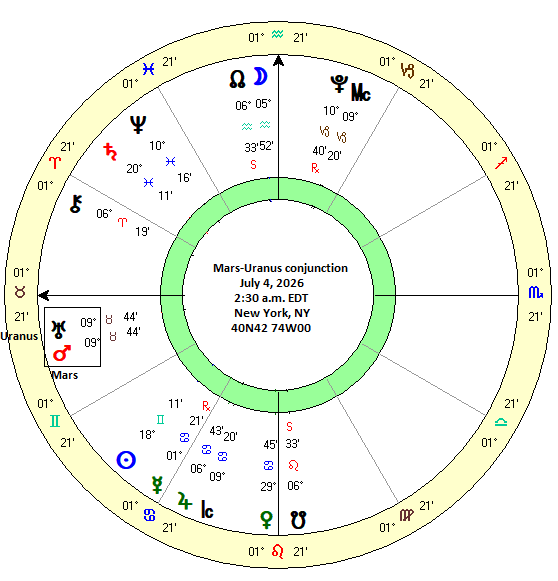
The July 4 Mars-Uranus conjunction
On July 4 the United States will celebrate the 250th anniversary of its founding in 1776. As it happens, that day will also be marked by the conjunction of Mars and Uranus. This conjunction occurs about once every two years and is often viewed with some trepidation by astrologers as it combines Mars’ tendency for conflict and violence with Uranus’ sudden and explosive energy.

While the Mars-Uranus conjunction is usually regarded as less troublesome than the square or opposition aspect, it still carries a negative overtone due to the malefic nature of Mars. This negative reputation may be somewhat undeserved, however, since Mars and Uranus also have favorable symbolisms. In its constructive mode, Mars connotes action, courage, energy and determination. When paired with innovative Uranus, this conjunction could represent ingenious problem-solving, a unique course of action, or a radical sense of freedom. In this way, the Mars-Uranus conjunction embodies one element of the American ethos, namely the desire for liberty above all else.
In market terms, the Mars-Uranus conjunction is also seen as a potential bearish influence. Some financial astrologers may warn of sudden, unpredictable moves and heightened volatility around the time of this conjunction. But is this true? Do Mars-Uranus conjunctions actually increase the odds of a sell-off or a market crash? Let’s look at the historical data and find out.
The table below shows the closing prices before and after all the Mars-Uranus conjunctions since 1951. The resulting dataset contains 41 cases. In order to determine its potential market effects, prices on the DJIA were recorded a 3-day intervals starting at 18 days before the conjunction (“-18d”) and continuing until 18 days after (“18d”) the conjunction. The price on the day of the conjunction is listed in the column labelled “0d”.
The summary statistics table below compares the price changes across various intervals. The first column (“-18d 18d”) shows the mean and median change over a 36-day window starting at 18 days before the conjunction until 18 days after. The second column (“-18d 0d”) shows the price change from 18 days before the conjunction up until the day of the conjunction. The results are clearly bullish. Every interval tested had a bullish lean and three intervals reached statistical significance. The longest interval (“-18d 18d”) was the most significant with a tiny p-value of 0.0006. The mean price change during that time was almost 3% compared with a 0.71% expected gain for the benchmark based on a 7.2% average annual return for the DJIA 1951-2024. While all the intervals leaned bullish, the most reliably positive outcomes occurred in the longer 24-day or 36-day intervals. These produced positive outcomes in 80% of the cases. This result suggests that the period immediately before and after the conjunction may be more indeterminate.
The cumulative trend chart illustrates just how bullish this conjunction is. Both the mean and median lines go straight up from their starting point 18 days before the conjunction and only experience a small dip 9 days afterwards. It should be noted that most of the bullish bias occurs in the period before the conjunction. For the current alignment, that translates to a stronger positive influence from June 16 to July 4.
Far from being a bearish influence, our study shows that the Mars-Uranus conjunction is usually positive for stocks. Obviously, this isn’t always the case as there were many instances of stocks falling around the time of this conjunction. But overall, this alignment has a bullish net lean.
Overview of Current Alignments
Given the possible bullish effect of the Mars-Uranus conjunction, how does this alignment fit in with the other alignments that are currently active? The chart below shows all of the above alignments according to their own effective periods and mean price changes. To keep things simple, the line for each alignment shows its mean price change only Most of the lines are above zero and reflect the mostly bullish market environment. Of course, these six alignments do not account for all the present and future variations in the market. There are still any number of unknown alignments which may also correlate with future price changes. In that sense, this is a very partial and incomplete overview.
While the overview seems mostly bullish, we should note the possibility of some market weakness after June 16 when Jupiter sextiles the NYSE Mercury. Once this alignment is past exact, our backtest shows a more negative bias may take hold. Since there is already some negative influence from the Mars conjunction to the NYSE Mercury from June 7 to June 25, some downside would not be surprising. The period between June 16 to June 25 would seem to be the more vulnerable period.
However, some of this weakness will likely be offset by the ongoing bullish influence of the Uranus-North Node square and the Mars-Uranus conjunction. Therefore, a large decline seems less likely at this time.
Implications for this week
The potential bullish impact of the Mars-Uranus conjunction may or may not impact markets this week. The backtest period started 18 days before the conjunction which translates to June 16. Some upside is possible this week, especially in the early week given the rare and powerful heliocentric alignment of Mercury, Venus, Jupiter, Uranus, Neptune and Pluto on Monday. Perhaps this represents the rally that accompanies the formal signing of a peace deal with Iran. Venus is the center of a similar alignment — albeit without Jupiter — in the geocentric chart on Monday.
The Mercury-Mars sextile approaches exact on Thursday and could unsettle the prevailing optimistic mood before the long weekend.

Disclaimer: Not intended as investment advice. For educational purposes only.


