(8 March 2026) Stocks fell across the board last week as investors reacted to the US-Israel attack on Iran. Oil prices spiked as Iran closed the Straits of Hormuz, a strategic bottleneck for the world’s supply of oil and natural gas.
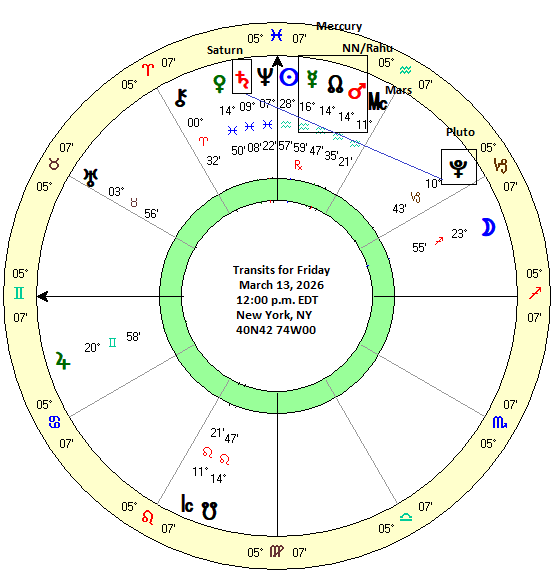
The selling was not unexpected given the ongoing bearish influence of several key alignments: the 105-degree Jupiter-Saturn alignment, the Mercury Rx-Venus and Mercury Rx-Sun conjunctions and the approaching triple conjunction of the Mercury Rx, Mars and the North Lunar Node.
But how much lower could stocks go? This is hard to say based on our analysis. Our backtesting only looks at average and median outcomes and thus produces probable scenarios based on the rules of standard deviation and statistical significance. Each individual market event need not conform to those statistical tendencies. But I would argue they are nonetheless useful to be aware of.
The updated cumulative trend charts of these alignments highlight the current bearish turn the market has taken. The Sun-Mercury Rx conjunction chart (below) is now trending (red line) much lower than the average and median blue lines. It could eventually mean revert higher but there is nothing to stop it from falling further as it is one data point among many.
The Jupiter-105-Saturn (2nd transit) chart is also now trending below its historical averages. While absolute levels cannot be predicted from charts like this, it is worth knowing that the down move typically bottoms out at 20 or 25 days after the alignment, at least based on the average. Since that alignment occurred on Feb 19, that would take us to March 11-16. Of course, there’s also no certainty in the shape and direction of that light blue average line.
The Mercury Rx-0-Venus conjunction chart is now below its long-term averages. With both the average and median trending higher from similar points in previous conjunctions, there would seem to be less bearish energy available at this time from this pairing. Moreover, it increases the chances for some kind of rebound going forward.
Similarly, the cumulative trend chart of the triple conjunction of Mercury Rx, Mars and the North Node may be close to forming an interim bottom. The median tends to bottom 6 days before the conjunction (i.e. March 9) while the average bottoms 3 days before (i.e. March 12). Again, there’s no guarantee that either line will predict what happens with the current conjunction. But it does somewhat boost the probability for a rebound this week upcoming.
A more challenging chart is the Saturn-60-Pluto chart. Backtesting showed that this was a bullish influence during the three or four weeks leading up to the exact alignment. This occurs on March 28 for the current iteration. And yet the chart is already sharply diverging from the average and median lines. It could undergo some mean reversion in the days ahead and start to climb back to the long term averages, at least partially. But here again, we have to acknowledge that this is only one alignment out of many that comprise the current planetary situation. Just because there is a single bullish alignment in March does not assure that a rebound will take place.
But it nonetheless provides some evidence for a bounce in the near term. The problem with this chart is that it may again be partially offset by the negative effects of Mercury-Mars-North Node after the triple conjunction on March 15.
Combining Alignment Effects
These conflicting charts highlights the larger methodological problem of combining the effects of different alignments. When dealing with historical averages, there are limits to what we can realistically forecast in terms of specific outcomes. The challenge is even greater when the sample sizes are small and the effect sizes are modest, even if some may reach statistical significance.
Below is a table of current alignments and their possible combined effects. The effects sizes are based only on the interval averages (not medians) which had the smallest p-value. These averages were divided on a pro-rated basis to reflect possible market effect over a 7-day period. The “Net Effect” is not intended to forecast of the size of the price change for any given week. Instead, it is a figure that tries to account for the combined effect of the various alignments for that particular week. It therefore should be read directionally rather than as an estimated price change. Hence, the “Net Lean” is either “Bullish” or “Bearish” based on whether the Net Effect is a positive or negative number.
This week’s Net Effect is 0.63% and therefore denotes a bullish bias for the market. To be honest, I don’t trust this number as this approach is still very much a work in progress. There are some obvious sources of error here such as failure to fully account for lesser effects when alignments are weakening outside their lowest p-value interval (i.e. highest statistical significance). An interval with a higher p-value may not be significant but can still reflect a bias. Another blind spot are all the unknown alignments which we have not included in our analysis — the “unknown unknowns” as they were once aptly described. Our working assumption is that alignments based on the divisors of the circle are the most important and yet that has never been proven. It is merely an astrological shorthand that simplifies how we work with the infinite complexity of the planets.
Implications for this week
While the Net Effect in the Alignment Calendar is positive, I would still be skeptical about the market this week. The bullish influence of the Saturn-60-Pluto alignment has to kick in at some point, although with Mercury retrograde backing into a tense conjunction with Mars and the North Node (aka “Rahu”) we should be open-minded about all possible outcomes.


Disclaimer: Not intended as investment advice. For educational purposes only.
If you would like to receive these market analysis posts as an email, please subscribe to my free Substack newsletter, Empirical Astrology.


