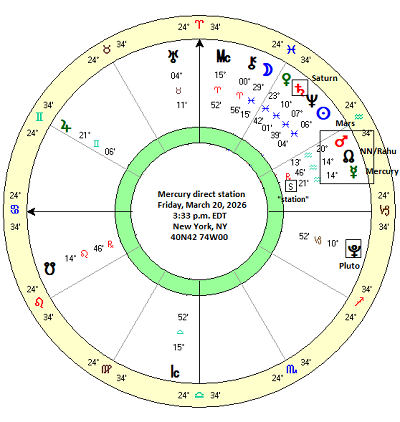
Triple conjunction fallout: will the Mercury station start a reversal?

(22 March 2026)  Stocks fell for the fourth straight week last week as the conflict in the Middle East showed no signs of abating.  With the Strait of Hormuz now largely blocked by Iran, Brent crude is trading well over $100 and supplies are running low in several Asian countries which import their oil from the Persian Gulf.

While I was uncertain if stocks would extend their decline, last week’s sell-off was not hugely unexpected given the March 15 triple conjunction of retrograde Mercury, Mars, and the North Lunar Node.  I thought the transit chart of that conjunction looked “ugly” and warranted some caution in the markets.  Data from previous triple conjunctions suggested a bearish bias in the days following the conjunction.  Also I had noted that the Mercury direct station on Friday, March 20 could coincide with additional weakness given its one-degree conjunction with the North Node (aka Rahu).  Mercury stations — both retrograde and direct — often correlate with trend reversals, especially when aligned with other planets as was the case last week.  Interestingly, the low of the day on Friday occurred at 3:37 pm — just four minutes after Mercury stationed direct.  Could Friday’s low therefore mark the bottom in the current down trend?  It’s certainly possible although whether it signals a more durable bottom is more of an open question.

The updated ME-0-MA-0-NN cumulative trend chart below highlights how bearish the current conjunction has been compared with the average and median.  While both lines have a bearish bias both before and after the day of conjunction, the extent of the current decline is noteworthy.  The cumulative chart has been directionally useful, although it has not approximated the size of the decline.

Other alignments have been similarly bearish but have not forecast the magnitude of the current sell-off.  The 105-degree alignment of Jupiter and Saturn (2nd transit only) is generally bearish after its exact alignment (Feb 19) although the current alignment (red line) is well below the average and median lines.  Both of those lines tend to rebound higher beginning at 25 days after the alignment (“25d”) but we’ll have to see if that pattern repeats here.

The transit of Saturn over 6 degrees of sidereal Pisces is also approaching a potential low in its average and median effects.  This transit is significant because it represents an exact 60-degree sextile alignment of transiting Saturn to the natal Sun in the NYSE chart.  The average and median lines are generally below the benchmark line and reflect the bearish bias of this alignment.  The sharper decline after the exact “0d” alignment typically occurs 20 to 30 days afterwards (“20d”, “30d”).  The current alignment’s red line is matching that pattern so far but it would have to turn higher over the next 5 days to follow its established pattern.  Of course, there is no guarantee that the current alignment will adhere to these trends given the fairly wide distribution of the data and the small sample size (n=10).

More puzzling is the ongoing divergence with the Saturn-Pluto alignment chart.  This 60-degree sextile alignment is exact on March 28.  Backtesting previous such alignments showed a clear and statistically significant bullish bias.  But stocks have fallen throughout this supposedly bullish preceding period.  Why?  One simple reason is that other factors — known and unknown — have offset whatever bullish influence the Saturn-Pluto alignment might exhibit.  Certainly, the triple conjunction and the Jupiter-105-Saturn alignment are both negative influences, even if their magnitude has exceeded their backtested averages.

The other reason is that even statistically significant results will sometimes have anomalous outcomes due to a wide distribution of the data.  The Saturn-60-Pluto alignment had an average gain of 3% during the 20 days leading up to the alignment but the sample had a standard deviation of 3.47%.  In other words, 68% of the results (= 1 standard deviation) would fall between -0.50% and 6.5%.  That’s a very wide range of outcomes.  Moreover, it also means that 32% of the outcomes actually fell outside of that range — both positive and negative.

This is a limitation in relying on aggregate data for forecasting.  Using averages and medians can provide insights about tendencies and trends in the data but it is more difficult to predict outcomes for specific cases.

Looking ahead: the April 19 Mars-Saturn conjunction

The short term market outlook is unclear.  The bullish influence of the Saturn-Pluto alignment remains elusive as the Mercury Rx-Mars-North Node conjunction is still the more active alignment.  But with Mercury now returning to direct motion after its March 20 station, it is possible that we could see a change in sentiment.  But even if we do get the long-awaited bounce, it is unclear how strong it will be.

The month of April looks eventful as Mars is set to conjoin Saturn.  The coming together of two malefic planets is good reason to pay attention, especially now as this will not be a garden variety once-every-two-years Mars-Saturn conjunction.  This time around they will be joined by Neptune within five degrees and Mercury, which will conjoin Mars and Saturn on April 19-20.  This will in effect be a quadruple conjunction of Mercury, Mars, Saturn and Neptune in sidereal Pisces and tropical Aries.  This has never happened during the 120-plus years of the Dow Jones Industrials.

Since it has no contemporary precedent, forecasting its market effects is very challenging.  One way to do it is to break it down into its constituent two-planet conjunctions.  The Mars-Saturn conjunction lies at its heart and should be considered first.  This conjunction occurs about once every two years.

The table below lists the DJIA closing prices at various intervals before and after the conjunction from 1951 to 2024.  The resulting dataset of 37 cases includes prices from 18 days before the conjunction until 18 days after the conjunction recorded at 3-day intervals.

The summary statistics table below analyzes the price changes across various intervals.  The first column is a 36-day window that begins 18 days before and ends 18 days after the conjunction (“-18d 18d”).  The second column lists the price change from 18 days before the conjunction to the day of the conjunction (“-18d 0d”) and so on until the shortest 3-day interval (“-3d 3d”).

The results are underwhelming.  Despite the malefic reputation of both Mars and Saturn, their conjunction doesn’t produce anything much at all.  No interval reached statistical significance and most were either neutral in their net lean or bullish.   Whatever you can say about it, you can’t say it’s bearish.

The cumulative trend chart below confirms this mostly neutral view of the Mars-Saturn conjunction.  Both the average and median lines mostly follow the benchmark line with minimal divergence along the way.

I have updated the Current Alignments Calendar to reflect these neutral results for the Mars-Saturn conjunction.  While a couple of intervals were a bit bullish, their p-values were too high to warrant a positive net effect for any particular weekly period.

But just because the Mars-Saturn conjunction is mostly neutral in its effects, that doesn’t mean that the quadruple conjunction with Mercury and Neptune will also be neutral.  In my next post, I will examine potential April outcomes given the addition of these two other planets.

Implications for this week

The Mars-Saturn conjunction is unlikely to have any effect this week.  Instead, markets may still be subject to the after effects of the March 15 triple conjunction and the approaching Saturn-Pluto alignment.  The triple conjunction of Mercury, Mars and the North Node has been quite bearish so far but this could change quickly since Mercury has reversed its direction after concluding its retrograde cycle on Friday, March 20.  While Mercury will still be in a close conjunction with the potentially disruptive effects of the North Node this week, its change in direction may be sufficient to introduce a new market dynamic. We’ll see.

The approach of the Saturn-Pluto sextile is another reason why markets could be more bullish this week.  Thus far, we have seen no evidence that the current alignment is a positive influence. But the alignment could get a positive midweek trigger when the Sun conjoins Saturn.  The late week Venus-Chiron conjunction could also introduce some positive energy into the mix.

I have added a couple more alignments to the calendar: the Saturn-Uranus septile alignment on April 25 and the Jupiter conjunct 6 Cancer (sidereal) on May 13. A septile aspect occurs when two planets are separated by 51.4 degrees, i.e. 360/7.  This produces a conjunction in the 7th harmonic (D-7, Saptamsa).  The Jupiter transit to 6 Cancer is significant because this creates a 120-degree trine aspect to 6 Scorpio, which is the position of the Earth in the NYSE heliocentric natal chart (sidereal).  On paper, this should be bullish.  I hope to backtest both of these alignments over the next week or two.

Disclaimer:  Not intended as investment advice.  For educational purposes only.

Get notified whenever we post something new!

Continue reading

Waiting for a rebound: Mercury retrograde ends March 20

(15 March 2026) Stocks fell for a third straight week last week as rising oil prices from the war with Iran reignited inflation fears.  Despite the geopolitical tensions and the flood of dramatic headlines, the current pullback sees the...

Combining alignment effects: assessing bullish and bearish influences

(8 March 2026) Stocks fell across the board last week as investors reacted to the US-Israel attack on Iran.  Oil prices spiked as Iran closed the Straits of Hormuz, a strategic bottleneck for the world's supply of oil and...

Markets sink on Iran war, Mercury Rx conjunctions

(4 March 2026)  US stocks are down are so far this week as investors weigh the geopolitical fallout of the US-Israeli attack on Iran.  The indexes fell sharply at the open on Tuesday but staged a substantial recovery by...

Enjoy exclusive access to all of our content

Get an online subscription and you can unlock any article you come across.