

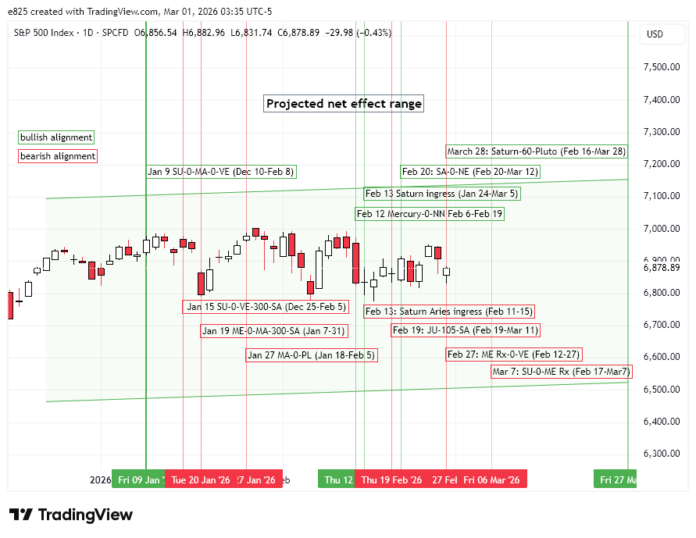
 (1 March 2026) US stocks finished modestly lower last week on higher-than-expected wholesale inflation data and renewed worries over the negative economic impact of AI. Not even the Nvidia earnings beat was enough to keep the market up. Despite the dip, most of the indexes remain very close to their all-time highs.
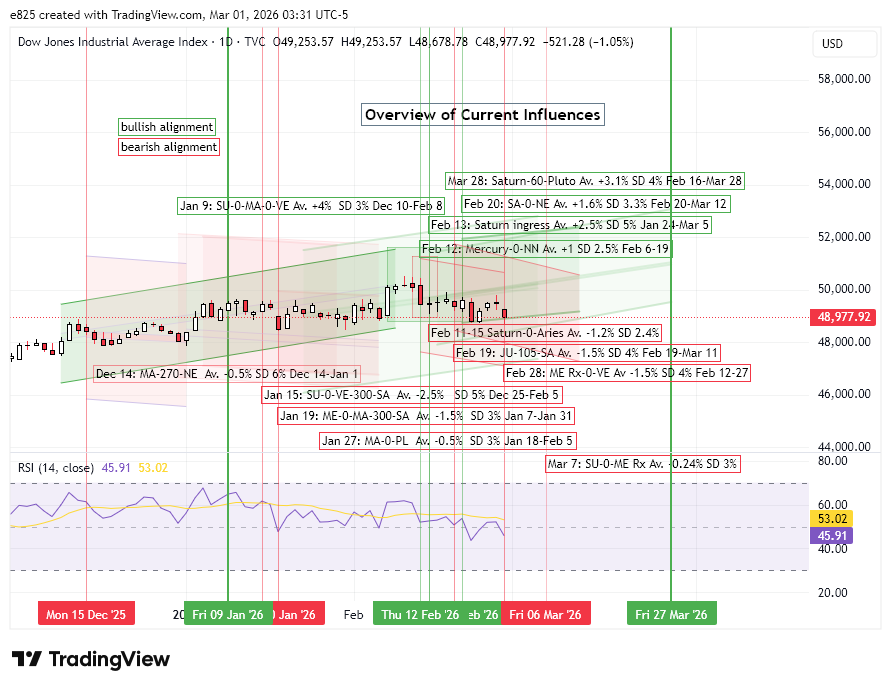
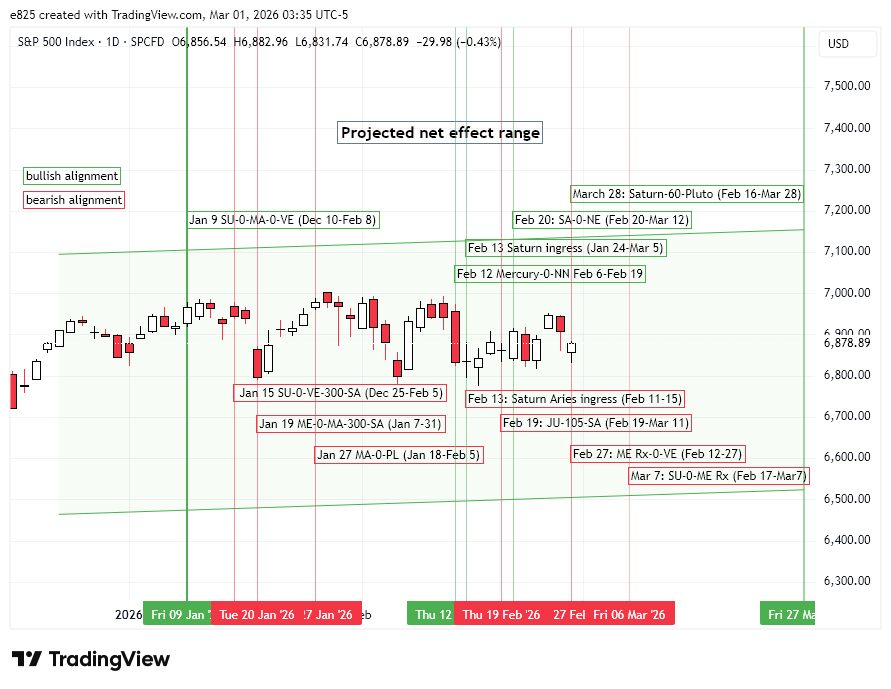
The decline was in keeping with expectations given the combined bearish effects of 1) Mercury retrograde on Feb 26, 2) Mercury Rx conjunct Venus on Feb 28 and 3) the Jupiter-105-Saturn alignment from Feb 19. Our backtesting of these influences suggested that all three could be bearish in the current period, even against a background of medium term bullish influences such as the Saturn-Neptune conjunction, the Saturn ingress into Aries and the approach of the Saturn-Pluto sextile on March 28.
Updating our cumulative trend charts, we can see that further downside is possible. Both the Mercury Rx-Venus conjunction and the Jupiter-105-Saturn alignment charts are tracking well above the long term averages and medians for those alignments. The current (red line) Mercury Rx-Venus conjunction (shown below) is still well above the benchmark and has yet to intersect with the blue lines. Of course, they don’t have to meet at all since every alignment is unique and does not have to adhere to long-term averages. This is particularly true in datasets with a wide distribution and large standard deviation (SD = 4%) as is the case here.
But as long as the red line is well above the blue lines, there is some downside risk as mean reversion may eventually kick in. At the same time, we are quickly approaching a point in the conjunction chart where the average and medians start to rise again indicating a bullish bias in the days ahead. For the average and median, this low point occurs on March 3 — i.e. 3 days after the Feb 28 conjunction. This doesn’t necessarily mean that stocks will begin to rise after March 3 but rather that the probabilities will shift slightly towards the bulls.
It is a similar story with the updated cumulative chart of the Jupiter-105-Saturn alignment. Current version of the alignment (red line) has fallen enough to meet the average and median blue lines and therefore may be poised to track the blue lines lower. Based on our backtest of 20 previous such alignments, there is a modest probability that we will see the DJIA fall further over the next week or two. Again, the usual caveats apply. Any single alignment need not follow previous trends. And since our study didn’t find any results that reached statistical significance, we must be careful about extrapolating from this chart. But the downside risk is nonetheless there.
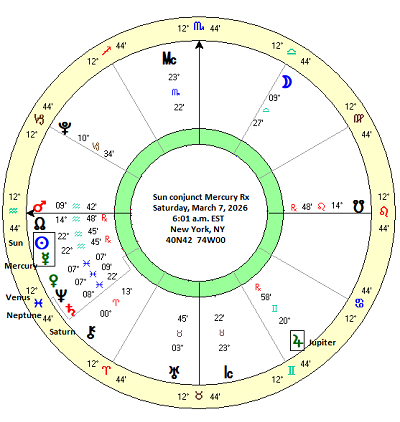
Mercury Rx conjunct Sun
Our focus this week will again by on the Mercury retrograde cycle. This time we will examine the market effects of Mercury’s conjunction with the Sun when it is retrograde. Mercury Rx is due to conjoin the Sun on Saturday, March 7, 2026. While my previous study of Mercury retrograde showed only a very small bearish bias overall, my hypothesis here is that conjunctions involving Mercury retrograde may be worse for the market rather than its apparent backwards direction alone. Mercury Rx conjunct Venus had a clear bearish bias so perhaps this extends to the Sun and other planets also. Let’s dive into the data and see what’s what.
The table below shows the S&P 500 closing prices at various intervals before and after the Sun conjoins Mercury retrograde for the years 2010 to 2026. The sample consists of 51 cases and is thus large enough to determine if there are any sufficiently robust trends. The first column (“-18d”) shows the prices 18 days before the conjunction, the second column (“-15d”) lists the prices 15 days before the conjunction and so on until the final column (“18d”) which gives the prices 18 days after the conjunction. If this pairing is bearish, then we should be able to see some clear negative trends around the time of the conjunction.
The summary statistics table below provides an overview of the price changes across various intervals. The first column (“-18d 18d”) shows the price change during the longest 36-day window with other columns listing the price changes for shorter intervals. The benchmark figure is based on an 11.7% average annual return for the S&P 500 during 2010-2025. Therefore, since the typical 36-day period during the tested period rose by 1.15%, a bearish result would have to have the average and median that was less than this figure.
While the average for the first “-18d 18d” interval was less at 0.50%, the median did not confirm and was actually higher than the benchmark at 1.36%. Without this mutual confirmation, it is harder to say that this result is bearish. Not surprisingly, the result was not statistically significant since the p-value was well above the standard 0.05 threshold at 0.322.
However, the second column (“-18d 0d”) did come very close to reaching significance (p = 0.079) and offered some limited evidence that the period leading up to the conjunction was indeed bearish. However, the effect was tiny (-0.24%) across an 18-day period. With the current conjunction set to take place on March 7, this would nonetheless be a headwind for stocks this week. No other intervals came close to statistical significance and most were either neutral or slightly bullish in their net effect.
This slight bearish bias can be seen in the cumulative trend chart below. While the median line more or less follows the benchmark line higher across the 36-day window, the light blue average line dips until the time of the conjunction and then moves higher once again.
Despite some very limited evidence for the bearish hypothesis, the Mercury Rx-Sun conjunction is a mostly neutral influence. Indeed, its close alignment this week with Jupiter is arguably somewhat bullish, especially towards the end of the week.
Implications for this week
While Sun-Mercury Rx conjunction may be mostly neutral in its effects this week, the other current alignments discussed above would still appear to elevate downside risk. Certainly, some increased volatility following the weekend US-Israel attack on Iran is likely. But how long it will last is unknown. A successful military campaign and quick regime change could even see markets rally for a while, if it a rally does not hold. But just in terms of these planetary alignments alone, there is some reason for continued caution this week.
I’ll try to put out a midweek update to see how markets have reacted to the Middle East situation.
Disclaimer: Not intended as investment advice. For educational purposes only.
