Surprisingly bullish: Mars-Pluto-Rahu

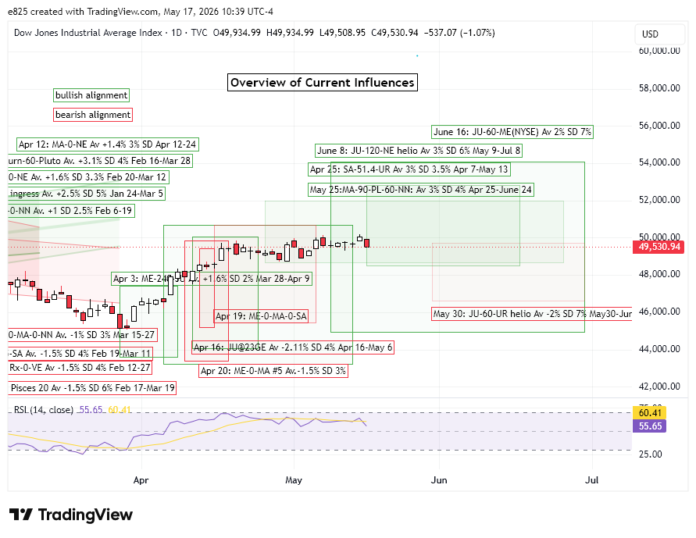
(17 May 2026)  Stocks were mixed last week as inflation worries pushed bond yields higher as the 30-year Treasury closed above the 5% level.  With no resolution in sight to the Iran conflict, investors are now beginning to factor in higher oil prices for an extended period.  The S&P 500 actually eked out a small gain last week while most of the other indexes finished modestly lower.

This mixed outcome was not unexpected as the post-alignment period of the April 25 Saturn-Uranus septile suggested choppy price action amid a generally rising market.  The updated cumulative trend chart of the sub-sample illustrates how the current 51-degree septile aspect is closely following the average and median.    While our study showed that the Saturn-Uranus septile is generally bullish, the cases in which there was a greater than 3% gain at the 0-day mark showed further upside after the alignment date, although the rate of increase was slower and the performance became choppier.


Overall, the current planetary alignments are broadly supportive of this rally.  Last week’s analysis of the Jupiter sextile to the NYSE Mercury suggested further upside was perhaps likely into June.  Moreover, the heliocentric alignment of Jupiter with Uranus, Neptune and Pluto over the next 4-6 weeks also appeared more bullish than bearish.

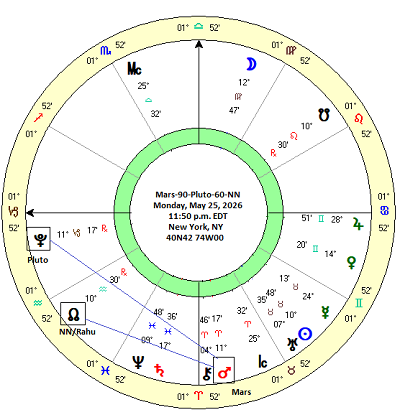
For this week’s post, I thought we could look at the potential price effects of a more immediate alignment, that of the Mars-Pluto square on May 25.  Actually, this Mars-Pluto square will also feature a simultaneous Mars-North Node sextile (or a Mars-South Node trine).  The resulting three-planet alignment is near-exact on May 25.

On paper, this alignment could be bearish since Mars is considered a natural malefic in traditional systems such as Vedic astrology and the 90-degree square aspect is usually seen as more tense and hence more likely to produce negative outcomes, especially with outer planets such as Pluto.  For its part, the North Lunar Node can be a wild card although in Vedic astrology, “Rahu” as it is known, is often seen as disruptive of the status quo and is also considered a naturally malefic planet.  Therefore, there is a prima facie case for some caution with the arrival of this Mars-Pluto-North Node alignment on May 25.  But as always, we need to first examine the data to see if its reputation is deserved.

The Mars-Pluto square

First, let’s look at the track record of the Mars-Pluto square.  My previous study evaluated its effects and found a slightly bearish but non-significant bias.  However, that study focused primarily on the 270-degree square in which Mars was three-quarters of the way through its synodic cycle from Pluto.  The upcoming Mars-Pluto square will see Mars 90 degrees away from Pluto by counterclockwise reckoning, i.e.it will have completed the first quarter of its synodic cycle with Pluto.  In Western astrology, the concept of a Mars-Pluto square includes both the 90- and 270-degree aspect and usually does not distinguish between them.  And yet as we will see, their market effects are actually quite different.

The table below lists the closing prices of the S&P 500 for the 28 most recent 90-degree alignments of Mars and Pluto starting from 1980.  In order to assess its effects, prices were recorded at 3-day intervals beginning from 15 days (“-15d”) before the square until 15 days after (“15d”).


The summary statistics table below shows the price changes across various intervals.  The results are impressive.  All intervals showed a bullish net lean and several reached statistical significance with several others coming very close to the 0.05 p-value threshold .  The first column (“-15d 15d”) gives the price change for the 30-day interval starting from 15 days before the square until 15 days after.  The mean and median posted gains of 2.32% and 2.62%  respectively — and both were well above the benchmark figure of 0.73% based on an 8.9% average annual return for the years 1980-2024.  While both the pre-alignment and post-alignment intervals were bullish, the pre-alignment intervals were a bit more bullish for most of the tested intervals.


The cumulative trend chart below highlights the overall bullish bias of the Mars-Pluto square.  Both mean and median lines are well above the benchmark throughout the 30-day backtest period.  The current alignment line in red is off to a slow start and is slightly below the benchmark.  Given its bullish tendency, it would not be surprising to see prices rise as the current alignment may well trend higher in the coming days.  Of course, each case is unique and need not follow the historical bullish tendency.  But the probabilities favor some upside over the next two weeks.


Is three a crowd?  Enter Rahu 

But what happens if we add Rahu (i.e. the North Lunar Node) into the mix?  When it is conjunct the Sun, the North Node is associated with eclipses, with all its disruptive potential.  Here its effects may be less prominent since it is only forms a 60-degree sextile with Mars.  And yet since it is taking place while Mars is in a square aspect with Pluto, there is a possibility for an amplified outcome.

This three-planet alignment has only occurred 20 times since 1896, which is the inception date of the Dow Jones Industrials.  In order to accommodate the relatively small sample size, we used the DJIA instead of the S&P 500.  We also lengthened the price testing intervals from 3 days to 5 days to create a longer backtest period.  The table below lists the prices of all 20 cases beginning in 1901 and culminating with the current alignment which will take place on May 25.


The summary statistics table below analyzes the price changes across various intervals.  Overall, there is also a bullish bias with this alignment.  The first column (“-30d 30d”) has a mean of 2.73% compared with a benchmark average of 0.84% for the 60-day period.  Several intervals reached statistical significance (p < 0.05) and several more came close.  While most of the intervals had a net bullish lean, a few were neutral with one actually being mildly bearish.  The bullish influence was somewhat stronger in the pre-alignment period compared with the post-alignment period.


This ‘very bullish before/less bullish after’ pattern shows up in the cumulative trend chart below.   The mean and median lines are generally above the benchmark but do show some signs of leveling off once they get past the “0d May 25” marker.  The current alignment (red line) is tracking the mean and median fairly closely and could easily follow them further which would suggest further upside over the next week or two.  At the same time, we should note that this is a very choppy chart which could reflect both ups and downs in stock prices.


Conclusion

The bottom line is that both the Mars-Pluto square and the Mars-Pluto-North Node alignment are mostly correlated with bullish price movements.  While some intervals were statistically significant in this regard, the percentage of positive outcomes was generally around 70-75%.  Although noteworthy, this cannot be a considered a strongly bullish influence.   Nonetheless, this would appear to further strengthen the prospects for further gains in the near term.

Implications for this week

The approach of these alignments should help to put a floor under stocks this week, even if they do not preclude more short term downside.  I would think that the late week Sun-Uranus conjunction would coincide with some upside in any event, although that is just my non-empirical opinion.

Disclaimer: Not intended as investment advice.  For educational purposes only.


Get notified whenever we post something new!

Continue reading

An unstoppable rally: Jupiter and the NYSE chart

(10 May 2026)  US stocks finished higher again last week as optimism about AI-related earnings outweighed the underlying geopolitical uncertainty.  The tech-heavy NASDAQ posted its sixth consecutive winning week and carried the S&P 500 and Russell 2000 along with...

Marco Rubio on the rise

(7 May 2026) The state of US politics is as volatile as ever.  Much of the uncertainty is due to President Donald Trump whose bull-in-a-china-shop mercurial style often leaves rivals and opponents exasperated and on the defensive.  The ongoing...

Appearances can be deceiving: the helio Jupiter-Uranus sextile

(3 May 2026) Stocks pushed higher last week as tech earnings from the likes of Apple and Google came in stronger than expected while jobless claims remained steady.  The S&P 500 and NASDAQ reached new highs, although the Dow...

Enjoy exclusive access to all of our content

Get an online subscription and you can unlock any article you come across.