

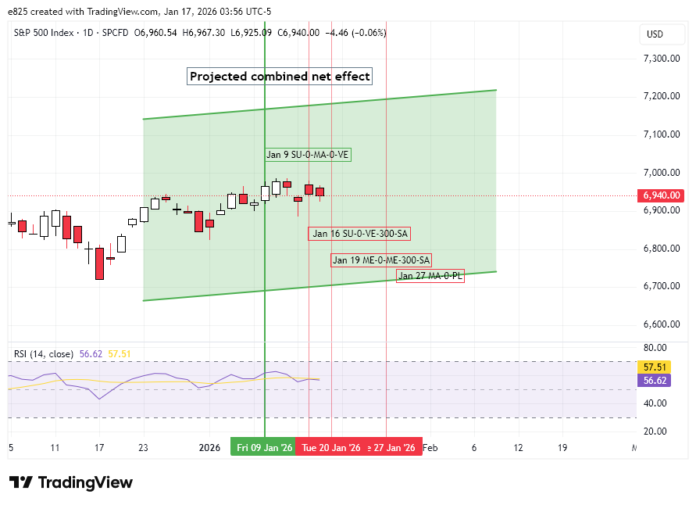
 (18 January 2026) Stocks ended the week slightly lower as investors pondered the future of the Fed’s independence after Trump’s latest comments about Fed Chair Jerome Powell. Despite the pullback, the S&P 500 did manage to make new intraday highs although it fell a bit short of the 7000 level.
This sideways consolidation is not unexpected given the current mix of planetary influences. The dominant influence is still the triple conjunction of Sun-Mars-Venus on January 9. My study suggested that this is a bullish influence that can last for several weeks after the exact conjunction. Backtesting of previous such conjunctions showed an average 4% gain across a 60-day window (i.e. 30 days before until 30 days after) and reached statistical significance (p<0.05) across multiple time intervals.
However, some of the bullish energy of this triple conjunction could be at least partially offset by the presence of some negative alignments in the second half of January. My post two weeks ago showed the potential negative impact of the Sun-Venus-Saturn alignment on January 15-16. The cumulative trend chart showed a bearish bias in the days following the exact alignment. Although noteworthy, the small sample of just 10 cases did not produce statistically significant correlations although a couple of intervals came close.
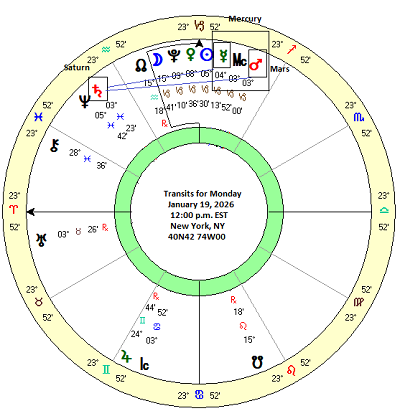
The second half of January features two other possible trouble spots for markets as Mercury conjoins Mars and sextiles (i.e. 60/300 degrees) Saturn on January 19-20 and then Mars conjoins Pluto on January 27. In this week’s post, we will examine the possible effects of the first of these alignments as Mercury and Mars will align with Saturn.
A second dose of Saturn
Just as the Sun and Venus aligned with Saturn last week, this week Mercury and Mars will form their own conjunction and thus enter into a similar sextile aspect with Saturn. The closest alignment occurs on Monday, January 19, although the Mars-Saturn sextile is exact the following day on January 20.
In order to gain a better understanding of the possible effects of this three-planet alignment, I broke it down into two samples: the first sample consisted of the more common Mars-Saturn sextile. The second sample was the much rarer Mercury-Mars-Saturn alignment. The Mars-Saturn sextile occurs about once a year whereas the Mercury-Mars-Saturn alignment in which Mercury conjoins Mars and both are 60 degrees away from Saturn has only occurred 11 times in the past 120 years.
Mars-60/300-Saturn
The table below shows the closing prices across a sequence of 3-day intervals on the Dow Jones Industrial Average (DJIA) for all 49 Mars-Saturn sextiles from 1980 to 2026. The sextile is a 60-degree aspect (the 360-degree circle divided into 6 equal segments) and is believed to represent a harmonious blending of energies between two planets. For the purposes of this study, I included both the 60-degree and 300-degree alignments according to standard counterclockwise reckoning. Both feature a 60-degree separation of Mars and Saturn with the only difference being whether Mars as the faster planet is applying or separating with the slower-moving Saturn…
To read the rest of this post, please visit my Empirical Astrology Substack
